Patient Information
Rubber Band Ligation (Banding) of Haemorrhoids
A quick and effective outpatient treatment for internal haemorrhoids, performed without sedation or a general anaesthetic.
Questions about banding? Anna Smith (Secretary) is happy to help.
What is rubber band ligation?
Rubber band ligation (often simply called “banding”) is the most commonly performed outpatient treatment for internal haemorrhoids. It is a quick procedure that is performed in the clinic without the need for sedation or a general anaesthetic.
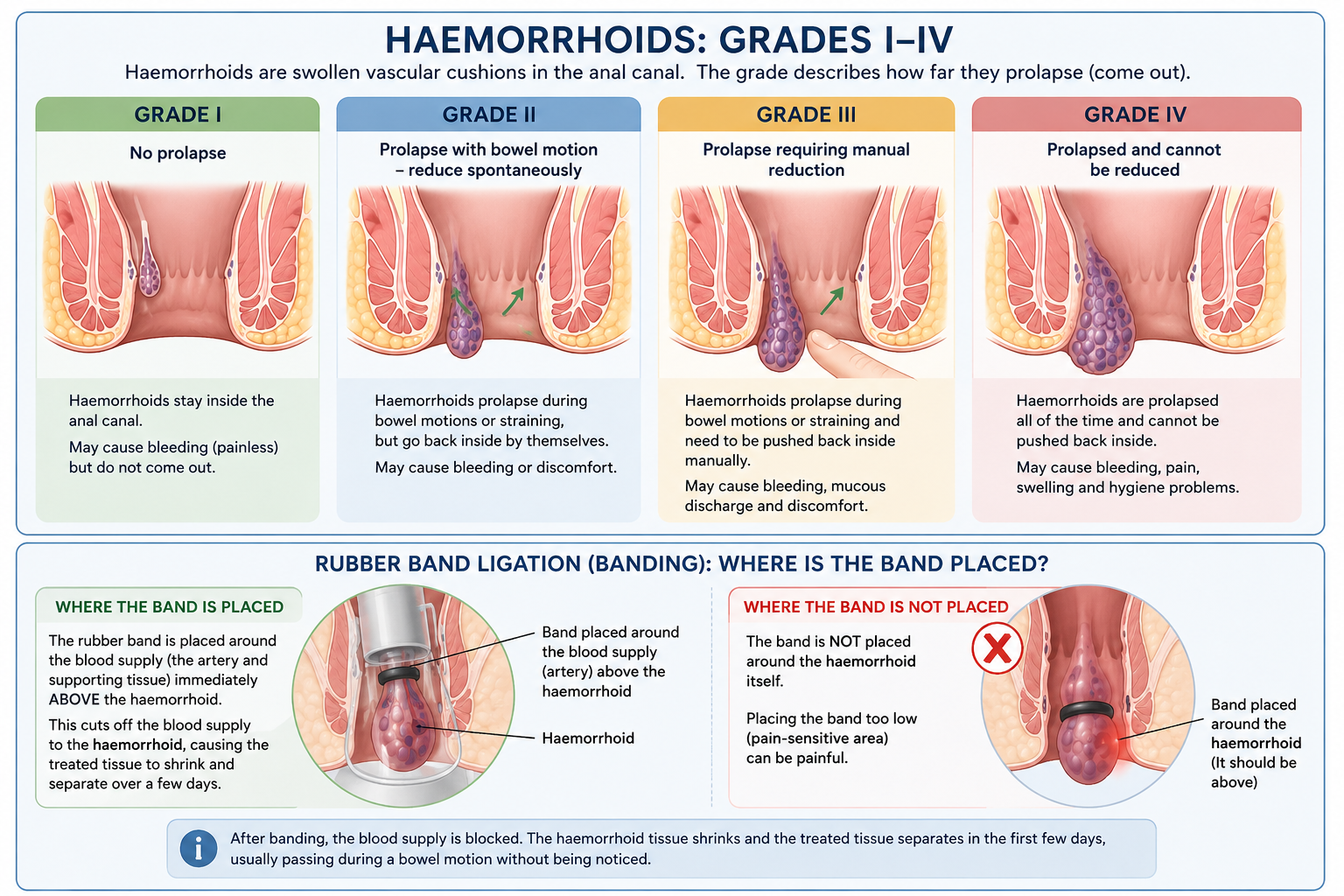
Rather than removing the haemorrhoid itself, the aim is to reduce its blood supply. A tiny rubber band is placed around the blood vessel immediately above the haemorrhoid. This interrupts the blood supply, causing the excess haemorrhoidal tissue to shrink. The treated tissue usually separates naturally over the following few days and passes unnoticed during a bowel motion.
Banding works best for Grade II haemorrhoids (those that prolapse during bowel motions but return inside by themselves) and selected Grade III haemorrhoids (those that need to be pushed back inside manually). It is particularly effective when bleeding is the main symptom.
Why do I recommend banding?
For many patients, rubber band ligation provides an excellent balance between effectiveness and convenience.
The procedure takes only a few minutes, is performed in the outpatient clinic without a general anaesthetic, and most patients are able to return to work and normal activities the following day. Recovery is usually straightforward, with only mild discomfort for a few days.
Although surgical haemorrhoidectomy has a lower recurrence rate for large prolapsing haemorrhoids, it is associated with considerably more pain and a longer recovery. For suitable haemorrhoids, banding is therefore often an excellent first-line treatment.
During your consultation, I will discuss whether banding is likely to give you a good result or whether another treatment would be more appropriate.
What happens during the procedure?
You will usually lie on your left-hand side while a small plastic instrument (proctoscope) is inserted into the anal canal.
Before the procedure, I usually apply Instillagel® local anaesthetic gel, which helps to reduce discomfort during the examination and treatment.
The haemorrhoid is identified and the rubber band is placed around the blood supply immediately above it, rather than around the haemorrhoid itself.
The procedure normally takes around five minutes.
What should I expect afterwards?
Most patients are able to walk out of the clinic immediately afterwards.
I usually recommend that patients remain in the waiting room for 15–30 minutes after the procedure before leaving. A small number of patients feel light-headed immediately afterwards, and this usually settles quickly with a short period of rest.
Although most patients are physically able to drive afterwards, I recommend arranging for someone to drive you home if possible. If you do drive yourself, please ensure that you feel completely well before setting off.
Most patients return to normal activities later the same day or the following day.
For the first few hours it is common to experience:
- A feeling of pressure or fullness in the back passage.
- The sensation that you need to open your bowels (tenesmus), even when there is nothing to pass.
- Mild aching or discomfort.
The discomfort usually settles over the first few days. The sensation of needing to open your bowels can occasionally persist for up to two weeks. Simple pain relief such as paracetamol or ibuprofen is usually all that is required.
For the first 6–12 hours after the procedure, it is sensible to avoid opening your bowels if comfortably possible. If you do need to open your bowels, try to avoid straining.
Continue to eat normally, drink plenty of fluids and keep your stools soft. Maintaining a high-fibre diet and, where appropriate, taking a fibre supplement or stool softener will help reduce discomfort during recovery.
Bleeding afterwards
A small amount of spotting is common during the first day or two after treatment.
Some patients also notice a small amount of bleeding several days later, when the treated tissue separates. This is usually minor and settles quickly without treatment.
Seek urgent medical advice
If you pass a large amount of fresh blood, feel faint or dizzy, or the bleeding continues, you should seek urgent medical advice.
Risks and possible complications
Rubber band ligation is a very safe procedure, but like all medical treatments it carries some risks.
Common side effects include:
- Mild discomfort or aching.
- A feeling of pressure or fullness.
- Temporary tenesmus.
- Minor bleeding.
Less common complications include:
- Significant bleeding, usually between 5 and 10 days after treatment when the treated tissue separates. Approximately 1 in 400 patients require admission to hospital because of bleeding. The risk may be higher in patients taking blood-thinning medication.
- Difficulty passing urine.
- Severe pain if the band slips onto the pain-sensitive lower part of the anal canal.
- Thrombosis (clotting) within an external haemorrhoid.
- Very rarely, a serious pelvic infection can occur. Although exceptionally uncommon, this requires urgent treatment.
Seek immediate medical attention
You should seek immediate medical attention if you develop severe pain, fever, increasing swelling around the anus or feel generally unwell after the procedure.
How successful is banding?
Rubber band ligation is one of the most effective outpatient treatments for internal haemorrhoids.
Overall, around 70% of patients experience a worthwhile improvement in their symptoms. It is particularly successful for treating bleeding haemorrhoids, while larger prolapsing haemorrhoids are more likely to require further treatment or surgery.
Some patients require more than one treatment session to achieve the best result.
Will the haemorrhoids come back?
Banding treats the haemorrhoids that are present but does not prevent new haemorrhoids developing.
Approximately one in four patients will experience recurrent symptoms over the following few years. Many can be successfully treated with repeat banding, while others may ultimately benefit from surgery.
Maintaining a high-fibre diet, drinking plenty of fluids, avoiding constipation and avoiding prolonged straining on the toilet all help reduce the chance of recurrence.
What are the alternatives?
The most appropriate treatment depends on the size of the haemorrhoids and the symptoms they are causing.
Alternative options include:
- Conservative management with dietary and lifestyle measures.
- Repeat rubber band ligation.
- Surgical haemorrhoidectomy.
- Haemorrhoidal artery ligation (HAL-RAR) in selected patients.
I do not routinely offer injection sclerotherapy. In my experience, rubber band ligation provides better long-term symptom control for most patients, while injection treatment has lower success rates and, although uncommon, can occasionally result in significant complications.
During your consultation, I will discuss the advantages and disadvantages of each option and recommend the treatment most likely to give you the best long-term outcome.
Helpful answers
Frequently Asked Questions
Can I drive home afterwards?
Although most patients are physically able to drive after the procedure, I recommend arranging for someone to drive you home if possible. I usually ask patients to remain in the waiting room for 15–30 minutes after treatment because a small number feel temporarily light-headed.
Can I return to work?
Most patients return to work the following day. If your work involves heavy manual labour, you may prefer to take a day or two off.
Will I see the rubber band come out?
Usually not. The treated tissue and rubber band normally separate within the first few days and pass naturally during a bowel motion without being noticed.
Can I exercise afterwards?
Gentle walking is encouraged immediately. I recommend avoiding heavy lifting, strenuous exercise or cycling for the first 48 hours, after which you can gradually return to your normal activities as symptoms allow.
Can I travel or fly?
Yes, although I generally recommend avoiding long-haul travel for the first 10–14 days after treatment because of the small risk of delayed bleeding.
What if my symptoms do not improve?
Although around 70% of patients experience worthwhile improvement after banding, some require a second treatment session. Larger prolapsing haemorrhoids are less likely to respond completely and may ultimately require surgery.
Will I need more than one treatment?
Possibly. If you have several enlarged haemorrhoids or larger Grade III haemorrhoids, it is often better to treat them over more than one session. This improves comfort and reduces the risk of complications.
I take blood-thinning medication. Can I still have banding?
Yes, but this needs to be discussed before your procedure.
Medications such as warfarin, apixaban (Eliquis®), rivaroxaban (Xarelto®), dabigatran (Pradaxa®), edoxaban (Lixiana®), clopidogrel, ticagrelor and prasugrel may increase the risk of bleeding after haemorrhoid banding.
Please do not stop any blood-thinning medication unless you have been specifically advised to do so.
The safest approach depends on the medication you take and the reason it has been prescribed. During your consultation, we will discuss your medication and decide together whether any changes are needed before treatment.
When should I seek urgent medical attention?
You should seek urgent medical advice if you develop:
- Heavy bleeding, particularly if you feel faint or dizzy.
- Severe pain that is not controlled with simple painkillers.
- Difficulty passing urine.
- Fever, increasing swelling around the anus, or feeling generally unwell.
These complications are uncommon but should be assessed promptly.
How can I reduce the chance of my haemorrhoids returning?
The most effective long-term measures are:
- Eating a high-fibre diet.
- Drinking plenty of fluids.
- Avoiding constipation.
- Avoiding prolonged sitting on the toilet.
- Avoiding excessive straining during bowel motions.
These measures reduce the risk of developing further haemorrhoids and improve the long-term success of treatment.
Ready to discuss your symptoms?
Initial consultation from £250 · Appointments usually available within days